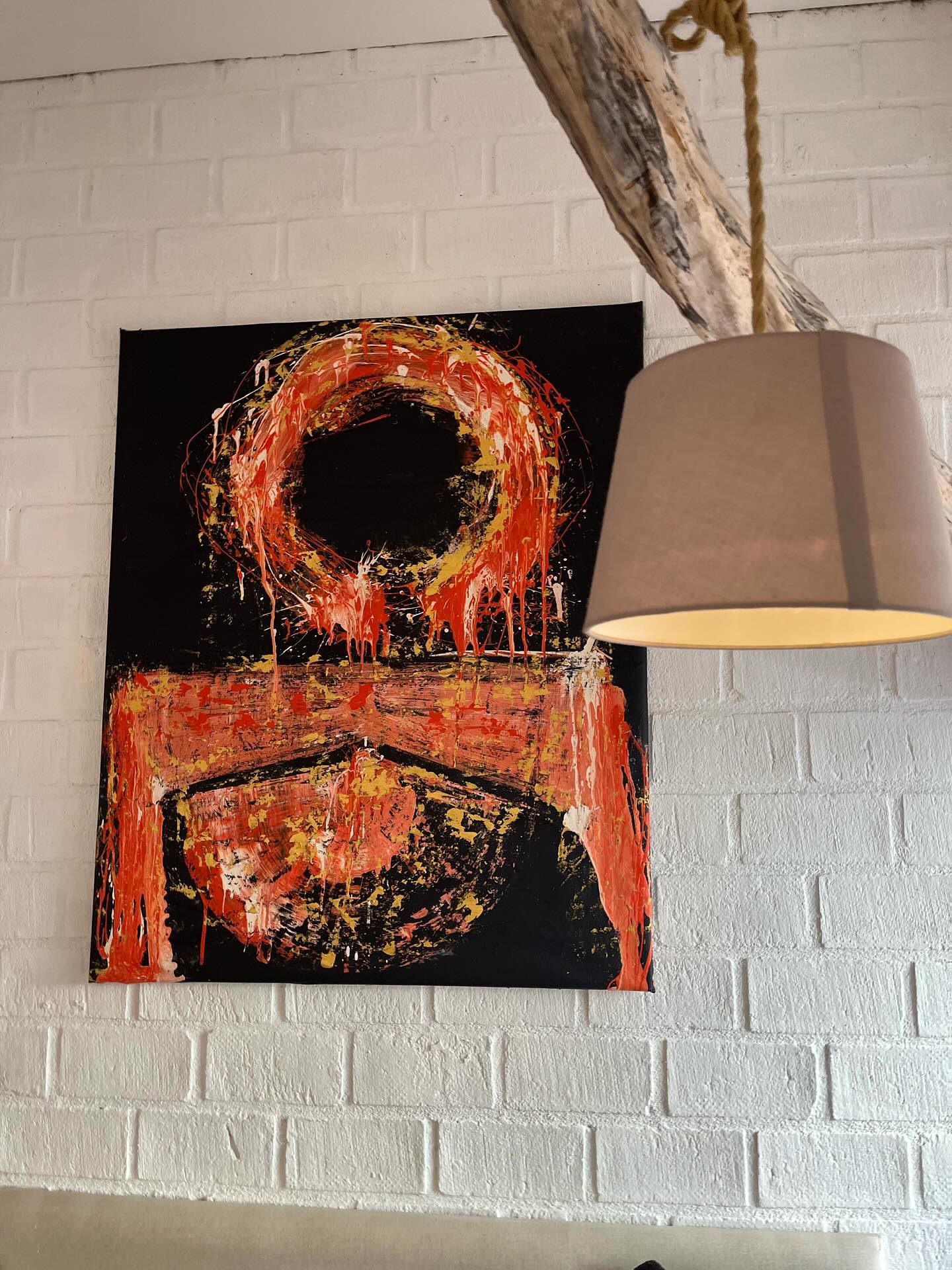
There's a particular kind of beauty in watching light bend through water. It's so ordinary we rarely notice it—sunlight passing through a glass, shadows shifting on a wall, the prismatic scatter when light meets a surface at an angle. These are everyday moments, invisible unless you're paying attention.
For me, they became everything.
The Winter That Changed My Practice
I moved to Paris in September 2023, arriving just as the days began to shorten. By November, the city was cold and dim—a stark contrast to Panama's relentless sunshine. I'd wake up in darkness and return to my studio as dusk fell. The absence of light became oppressive, almost suffocating.
But scarcity breeds attention. When something becomes rare, you notice it differently.
I started watching how light moved through my studio. The way morning sun caught dust particles. How shadows fractured across textured canvas. The precise moment when light met surface and transformed. I wasn't just seeing light anymore—I was seeing refraction, the physics of light bending as it passes from one medium to another.
And suddenly, I had my metaphor.
Refraction as Metaphor for Human Experience
Refraction happens at a threshold. Light travels through air, encounters glass or water, and changes direction. It's a moment of transition, of transformation—the instant when one state becomes another.
Isn't that what we're all doing? Moving through life, encountering moments that change our trajectory, bending toward something we can't fully predict?
In my work, refraction became a way to explore what happens in those in-between spaces. The moments before understanding arrives. The pause between stimulus and response. The threshold where the external world meets internal experience.
I'm not interested in imposing meaning. I'm interested in creating conditions for meaning to emerge—just like light creates conditions for refraction when it meets the right surface at the right angle.
The Three Phases: A Framework for Seeing
I began breaking refraction into three distinct phases, each one offering a different entry point into the work:
The Incident – Light traveling toward a surface. This is potential, movement, everything that exists before contact. In human terms, it's the approach: experiences coming toward us, moments we're about to encounter.
The Point of Incidence – The precise instant light meets surface. This is the threshold, the contact point where change becomes inevitable. It's the moment of meeting, where external reality touches internal experience. Energy concentrates here. Everything is about to transform, but hasn't yet.
The Refraction – Light bending, scattering, revealing structures that were always there but invisible until now. This is the transformation itself, the moment when something ordinary becomes revelatory.
Each phase carries its own visual and emotional language. Each invites different questions about how we experience being present in the world.
My Technical Approach: Chromatic Flattening
To translate these ideas visually, I developed what I call chromatic flattening—a technique that allows saturated colors to coalesce organically across layered geometric forms.
I work with metals, pastes, and acrylics on self-primed canvases. The process begins with fluid pouring into structured canvas elements. Colors meet each other at different rates, converging and assembling in ways I can guide but never fully control. As layers interact, they create what I think of as visual refractions: moments where color and form bend into something unexpected.
The technique is deliberate but not controlling. I'm creating conditions, not dictating outcomes. The work emerges through a dialogue between intention and chance—which is, again, a kind of refraction. My intentions meet the materials' properties, and something else emerges at that threshold.
Why Everyday Objects Matter
There's an irony I love: the most profound introspection can come from the most ordinary phenomena. A refraction of light. A shadow on a wall. The way color shifts at different times of day.
We live in a world designed to accelerate us—faster consumption, constant stimulation, relentless distraction. Urban life, especially, fragments attention. We're always moving toward the next thing, rarely pausing to notice what's actually present.
Refraction, as both phenomenon and metaphor, offers something different. It asks us to slow down. To notice. To pay attention to transitions we'd normally miss.
My goal with this work is to create space for that kind of attention. Not to tell viewers what to feel, but to invite them into a visual environment where introspection becomes possible. Where beauty and the fractured coexist. Where meaning isn't imposed but discovered.
The Observer Completes the Work
Abstract expressionism has always understood something fundamental: the work isn't finished until someone engages with it. The observer brings their own experience, their own associations, their own emotional landscape—and that becomes part of the piece.
I don't create meaning alone. I create visual structures that invite meaning-making.
When you stand in front of one of my pieces, you're not receiving a message I've encoded. You're entering a space I've constructed, and what happens there depends on what you bring with you. Your memories. Your current emotional state. Your willingness to pause and be present.
In this way, viewing abstract art is itself a kind of refraction. Your experience meets the work, and something new emerges at that point of contact.
Synergy Between Beauty and the Fractured
I'm drawn to work that holds complexity without resolving it. Beauty that acknowledges brokenness. Structure that contains fluidity. Geometry that makes space for organic emergence.
My pieces often layer saturated colors within geometric frameworks—hard edges containing soft transitions, precise forms allowing chromatic bleeding. This tension is intentional. It reflects how I experience contemporary existence: structured but unstable, beautiful but fragmented, meaningful but never fully resolved.
The refraction collection explores this directly. Each piece examines how light—something pure, essential, undeniable—becomes complex, layered, revelatory when it encounters matter. How the simplest phenomena contain infinite variation.
Creating Space for Introspection
The ultimate goal isn't aesthetic. It's experiential.
I want to create work that functions as a pause—a moment where the viewer can simply exist without agenda, without productivity, without the pressure to move on to the next thing. A space oriented toward what I call "absolute personal introspection."
This isn't escapism. It's the opposite. It's coming back to presence, to awareness, to the human and spiritual experience that constant distraction obscures.
Refraction shows us that ordinary light contains extraordinary complexity—but only if we slow down enough to notice. My work asks the same question of viewers: what becomes visible when you pause to look closely?
The Philosophy Moving Forward
As the refraction collection evolves, I'm continuing to explore these questions through different formal approaches. Some pieces examine urban rhythms—how movement and light interact in city spaces. Others investigate color relationships under different lighting conditions, studying how perception shifts between day and night.
But the core philosophy remains: transcending meaning in everyday objects. Finding depth in the ordinary. Creating visual spaces that invite introspection without imposing interpretation.
Refraction isn't just my subject matter. It's my methodology, my metaphor, my way of understanding what art can do when it prioritizes presence over distraction, being over consuming, invitation over imposition.
In a world that constantly demands our attention, refraction reminds us to notice what's already here—and discover that the everyday contains everything we need to understand ourselves more deeply.