The City as a Moving Light Source
Cities never really stand still. Even in their quietest hours, there is motion—a subtle pulse that shifts between people, surfaces, and light. When I arrived in Paris, I became increasingly aware of how these rhythms shaped my perception. Light behaved differently here. It fractured across buildings, bounced off metal, and danced over windows in ways that felt both structured and unpredictable.
Rhythms and Reflections began in that observation. If Composition of a Refraction was born from scarcity of light, this series emerged from its constant movement.
Urban light became a partner—an active force shaping the work.
Movement as a Form of Refraction
I started noticing that the way light interacts with the fast tempo of the city mirrors the emotional texture of human experience. There’s something deeply revealing in how brightness shifts with the rhythm of passing cars, bicycles, crowds, and the changing sky.
Light never moves alone. It responds to the world around it. It bends, interrupts, reveals, and reinterprets. That is exactly what refraction does.
In this series, I approached refraction not as a static phenomenon but as something fluid—something shaped by the energy of urban life. Refraction became movement. Movement became language.
Geometric Sequences as Urban Echoes
To translate this visually, I built the compositions using geometric sequences that echo the repetitive structures of a city: windows in continuous rows, overlapping pathways, shifting shadows, and vertical tensions between old and modern facades. These shapes create a framework that holds the movement while allowing the color to expand beyond it. The geometry gives order; the chromatic transitions give breath.
This tension between containment and overflow mirrors the way cities feel: organized yet chaotic, predictable yet full of interruptions.
Chromatic Flattening as a Study of Light Intensity
The technique remains grounded in chromatic flattening—layers of saturated color that merge without traditional shading. But in this series, the technique behaves differently. It reacts to the rhythm of daytime light, the metallic echoes of streetlights, and the deep-blue saturation that arrives with night. Color becomes temporal. You can feel the hour of the day in the density of the tones.
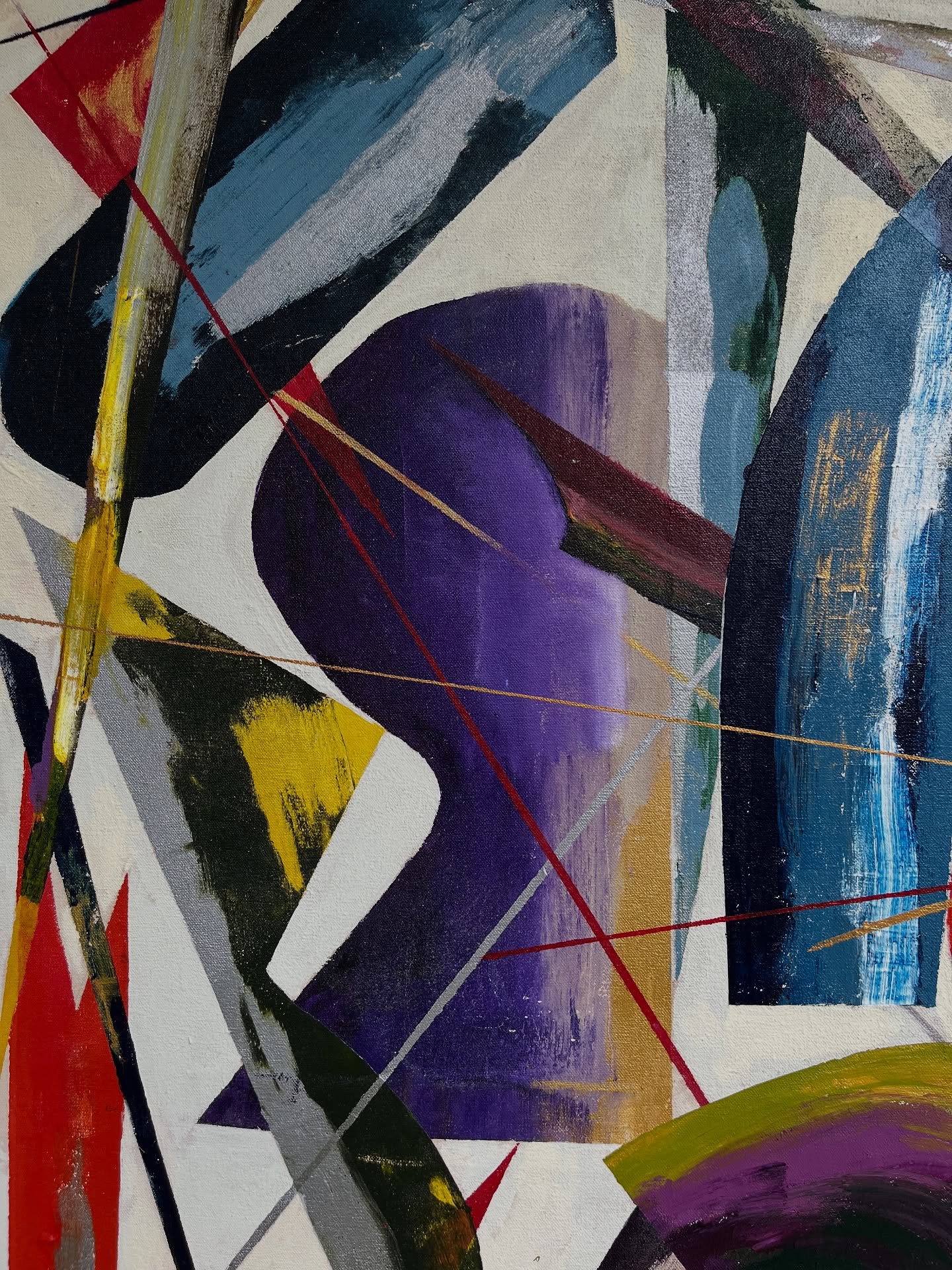
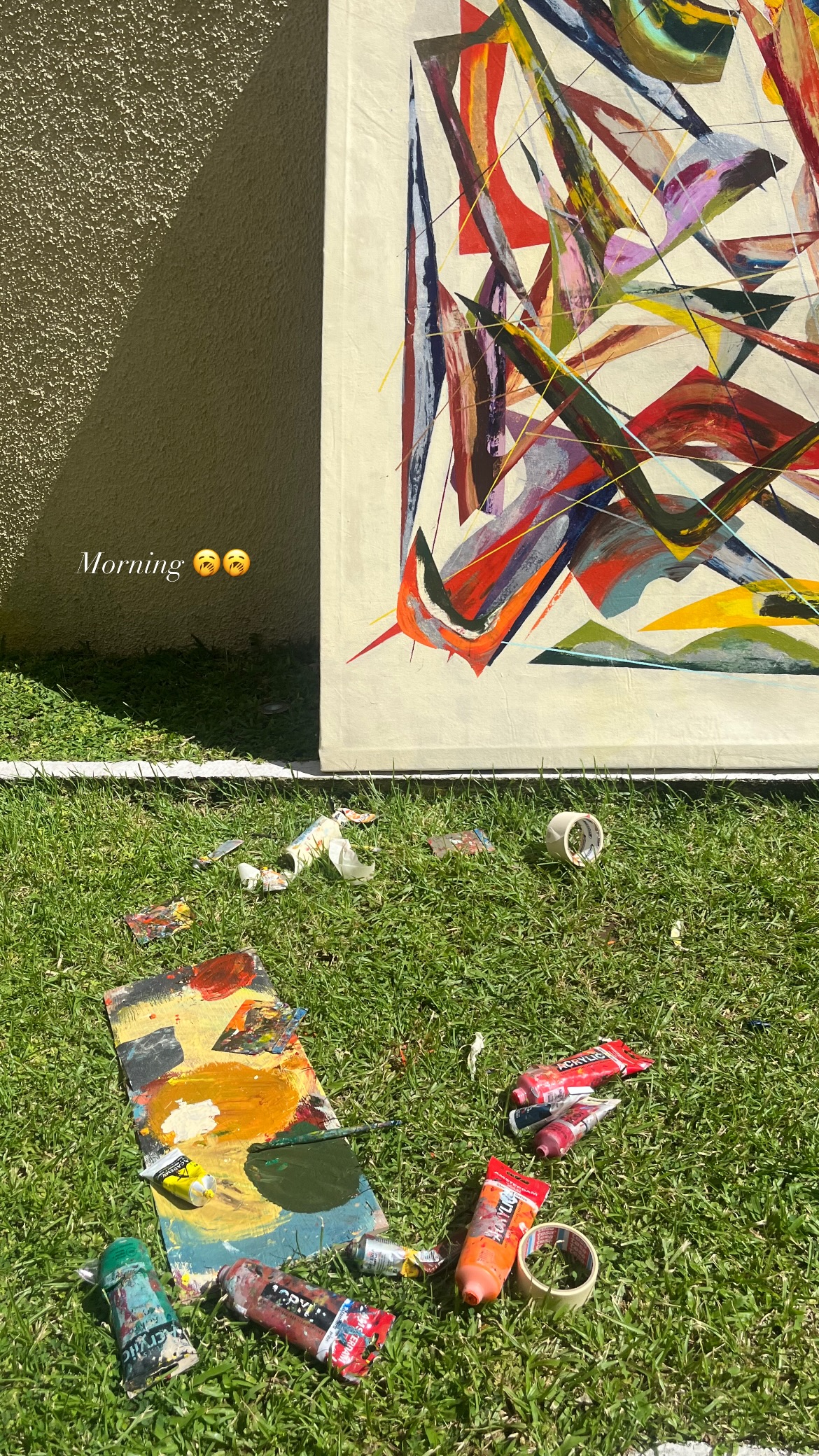
In Rhythms and Reflections I, the palette leans toward deep blues and metallic accents, organized according to light intensity—bright fragments contrast with muted fields, suggesting the acceleration and deceleration of the city.
In Rhythms and Reflections II, the chromatic transition becomes the subject itself. Daylight and nighttime refract differently, producing two chromatic territories that coexist in a single surface. The piece becomes a study of how perception shifts over time.
Revealing Patterns Hidden in Everyday Movement
What interests me most is that these optical interactions—so common and so overlooked—contain structures that quietly shape our experience. Urban life is full of repetition: the same commute, the same street corners, the same sounds. Yet within that repetition, there are micro-moments of beauty: a sudden reflection in a window, a shadow stretched longer than usual, the metallic glow of a passing bus.
Rhythms and Reflections captures precisely that duality: the ordinary and the extraordinary, the routine and the unexpected.
Refraction as a Way of Paying Attention
Just like in physics, where refraction reveals what is otherwise invisible, these works aim to uncover the subtle emotional landscapes created by movement. They ask for slow looking. For attention. For presence. When viewers stand before the pieces, I hope they sense a certain vibration—a pulse that echoes the rhythm of their own environment. Because the city, in its constant transformation, becomes a mirror for our internal shifts.
A Continuation of the Refraction Inquiry
This series extends the conceptual foundation of my refraction work. If Composition of a Refraction explores internal clarity and fragmentation, Rhythms and Reflections turns outward, looking at how external rhythms shape perception. Both speak to the same truth: light, in all its forms, reveals what is already there—inside us and around us.