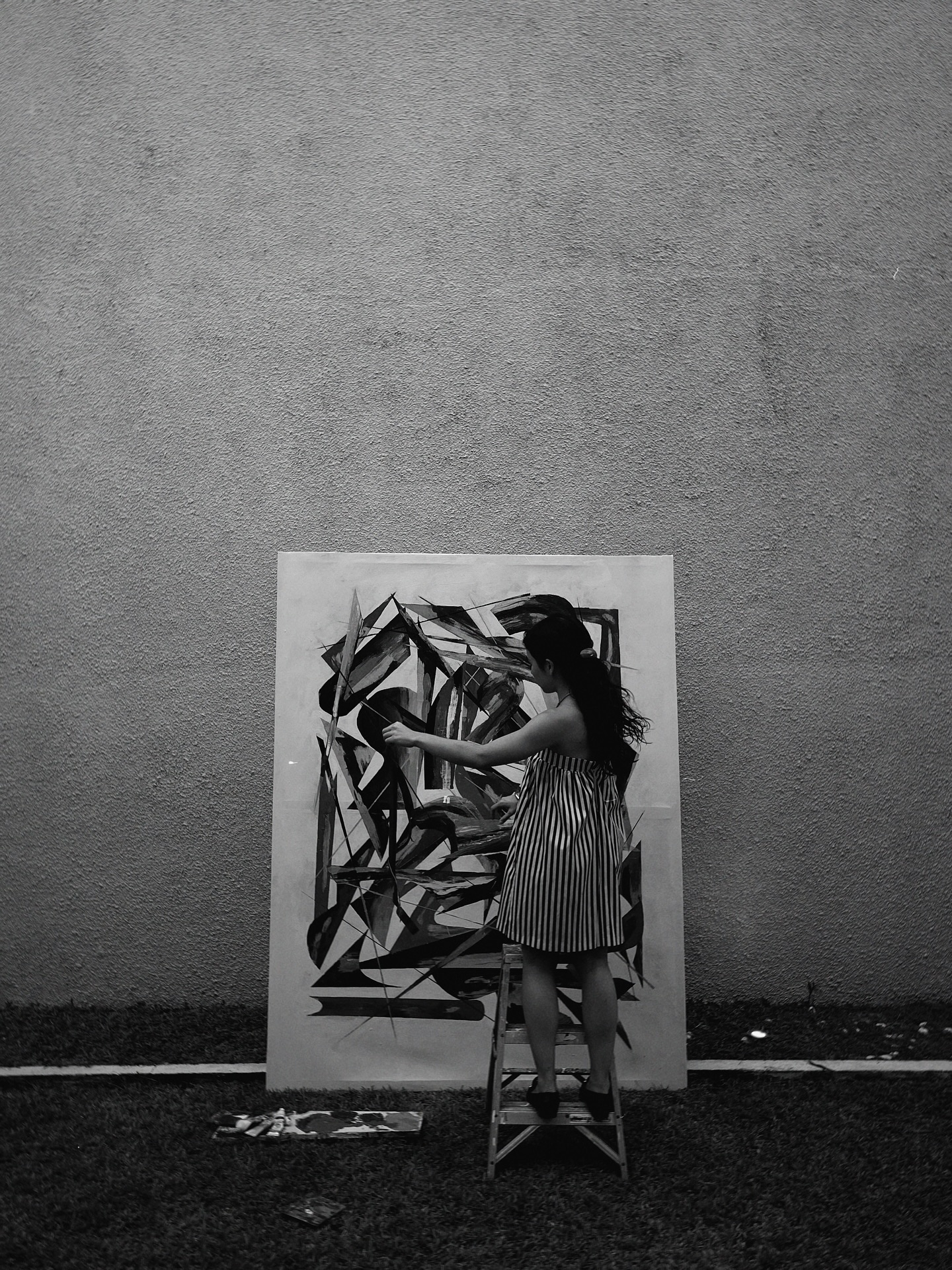
People often ask if I still play piano. The answer is complicated. I don't perform professionally anymore. But piano shaped how I think visually in ways I'm still discovering.
Growing up, I understood form through music before I understood it through visual art. Sonatas have architecture. Compositions have rhythm, tension, resolution. Music taught me that abstract systems could communicate profound emotional content without depicting anything recognizable.
That foundation proved invaluable when I moved into visual art.
The Piano Years
I trained as a pianist from childhood. It was rigorous, demanding, beautiful. Piano taught me discipline. How to practice deliberately. How to work toward mastery through repetition and refinement. How to recognize when something wasn't working and how to diagnose the problem.
But more importantly, piano taught me to hear structure. Every composition has internal logic—themes that recur, variations that transform, moments of tension and release. Understanding these patterns in music became a framework I later applied to visual composition.
What Piano Taught Me About Visual Composition
Counterpoint: In music, counterpoint is how independent melodic lines interweave while maintaining their individual integrity. In visual art, I think about how colors and geometric forms interweave. How they maintain their individual character while creating unified composition.
Variation: In music, a theme is introduced, then developed through variation. The listener recognizes the original theme even as it transforms. In my refraction collection, I explore the same subject (light refraction) through different formal approaches. Each piece recognizes the central theme while varying the treatment.
Dynamics: Music has loud and soft, intense and delicate. Visual art has analogous dynamics. Saturated colors versus muted, large forms versus small, busy areas versus restful. The interplay between dynamic extremes creates engagement and prevents monotony.
The Disciplines Inform Each Other
I don't play piano professionally, but I haven't abandoned music. Instead, music has become integrated into my visual practice. When I'm composing paintings, I often listen to music—not as background, but as active compositional tool.
Listening to pieces I learned as a pianist—Bach, Chopin, contemporary composers—reminds me of structural principles I might apply visually. How does a Bach fugue manage multiple simultaneous lines? That's valuable knowledge for thinking about chromatic relationships.
Conversely, my visual work has deepened my understanding of music. Creating abstract visual compositions has made me understand emotional communication more deeply. That understanding feeds back into how I conceptualize art theoretically, even though I'm not performing.