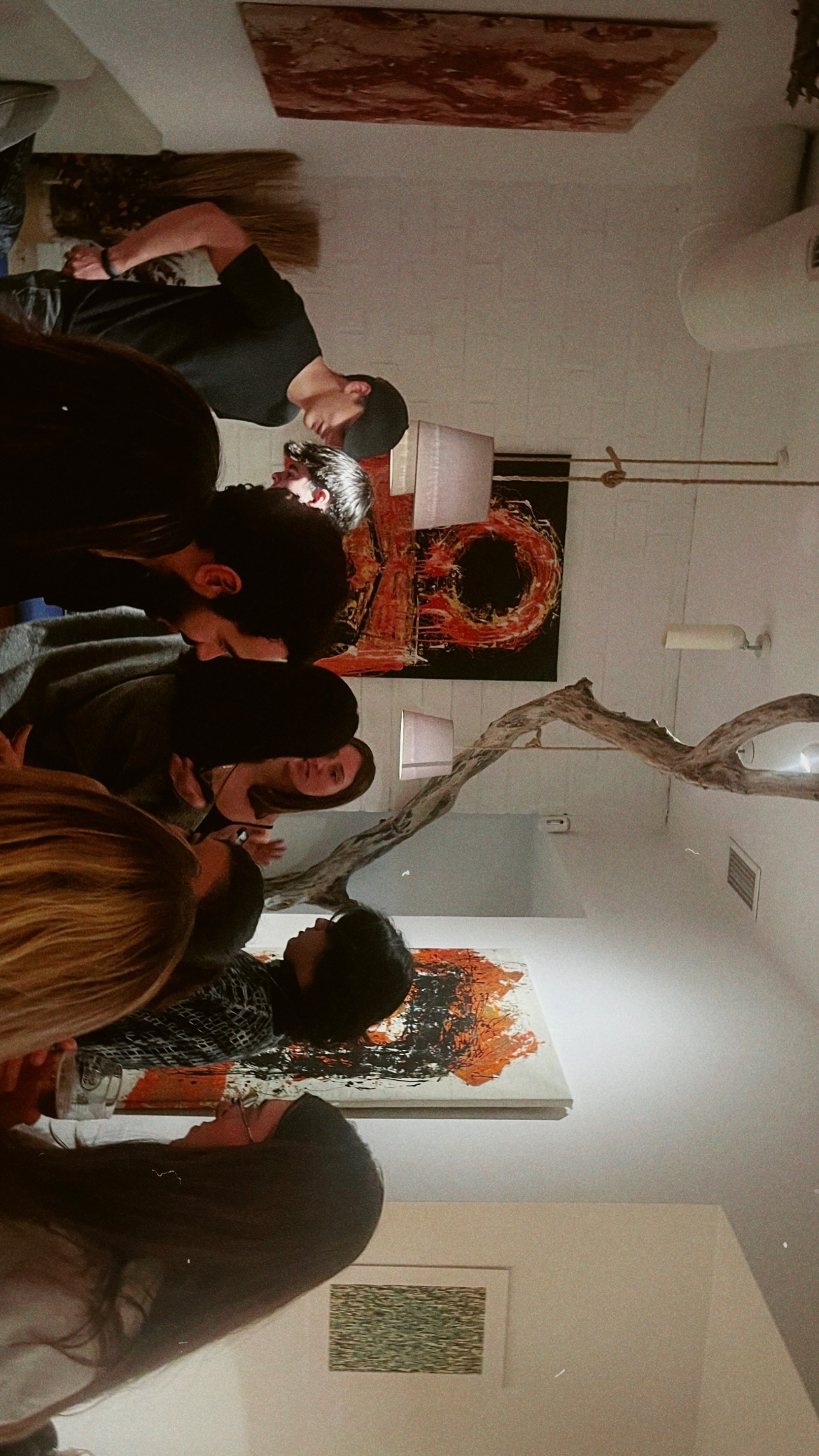
"Show me a feeling" isn't a question. It's a challenge.
How do you make visible what exists only internally? How do you translate the invisible architecture of emotion into color, form, and gesture? How do you create a painting that doesn't depict feeling, but enacts it—creates conditions for the viewer to feel something analogous to what moved you to create?
That's the question behind the "Show Me a Feeling" series.
Where the Series Came From
Every series emerges from a specific moment of creative crisis. For this collection, that moment came during my transition between Madrid and Paris—a period of significant personal and geographic upheaval.
I was questioning everything: my artistic direction, my relationship to the work, whether the pieces I was creating actually communicated what I was trying to express. I'd built technical facility, established professional relationships, created exhibitions. But I felt something missing—a directness of emotional communication that transcended technique.
The series emerged from asking: What if I stripped away everything except the feeling? What if I created work oriented purely toward emotional transmission rather than conceptual framework?
The Creative Process
Unlike the refraction collection, which develops from systematic exploration of a phenomenon, "Show Me a Feeling" emerged from intuition and spontaneity.
I began by working very quickly. Pouring acrylics without extensive planning. Allowing the materials to suggest what I should do next rather than imposing predetermined direction. The chromatic flattening technique was still present, but deployed differently—less controlled, more responsive.
The resulting pieces contain visible urgency. Traces of quick decisions. Color layered almost frantically in some areas, sparse and considered in others. The paintings feel unresolved in places, intentionally. They're meant to suggest the non-linear, often contradictory nature of actual emotional experience.
The Emotional Vocabulary
Every emotional state has a visual language if you pay attention long enough. Through this series, I discovered mine:
Vulnerability appears as thin washes where the canvas shows through—surface isn't fully protected, there's exposure. Containment shows as dense, interlocking geometric forms that don't quite allow the eye to rest. Release appears as areas where color bleeds beyond intentional boundaries, where the work exceeds its own structure.
I'm not saying these visual languages are universal. But they emerged consistently throughout the series, suggesting they reflect something about how I personally experience and externalize emotion.
The work never depicts specific feelings—anger, joy, grief. Instead, it creates conditions where viewers might recognize the emotional architecture they know from their own internal experience. The piece becomes a mirror not of appearance, but of affective landscape.
The Relationship to Abstraction
This series deepened my understanding of what abstraction can do that representation cannot.
A realistic painting of a heartbroken figure tells you about heartbreak intellectually. You observe it from outside. But an abstract painting oriented toward emotional transmission can create conditions where you experience something internally, where emotion becomes something you participate in rather than observe.
That's the power of abstraction—not that it avoids meaning, but that it shifts how meaning is transmitted. It moves from intellectual understanding to embodied experience.
Connection to the Broader Practice
"Show Me a Feeling" doesn't replace my other research. It exists alongside the refraction collection, alongside my technical investigations. But it revealed something essential: my work needs both intellectual rigor and emotional directness.
The refraction collection asks viewers to slow down and notice. "Show Me a Feeling" asks viewers to notice what they're already feeling—to recognize emotional patterns that usually remain invisible.
Together, they create a more complete artistic statement.