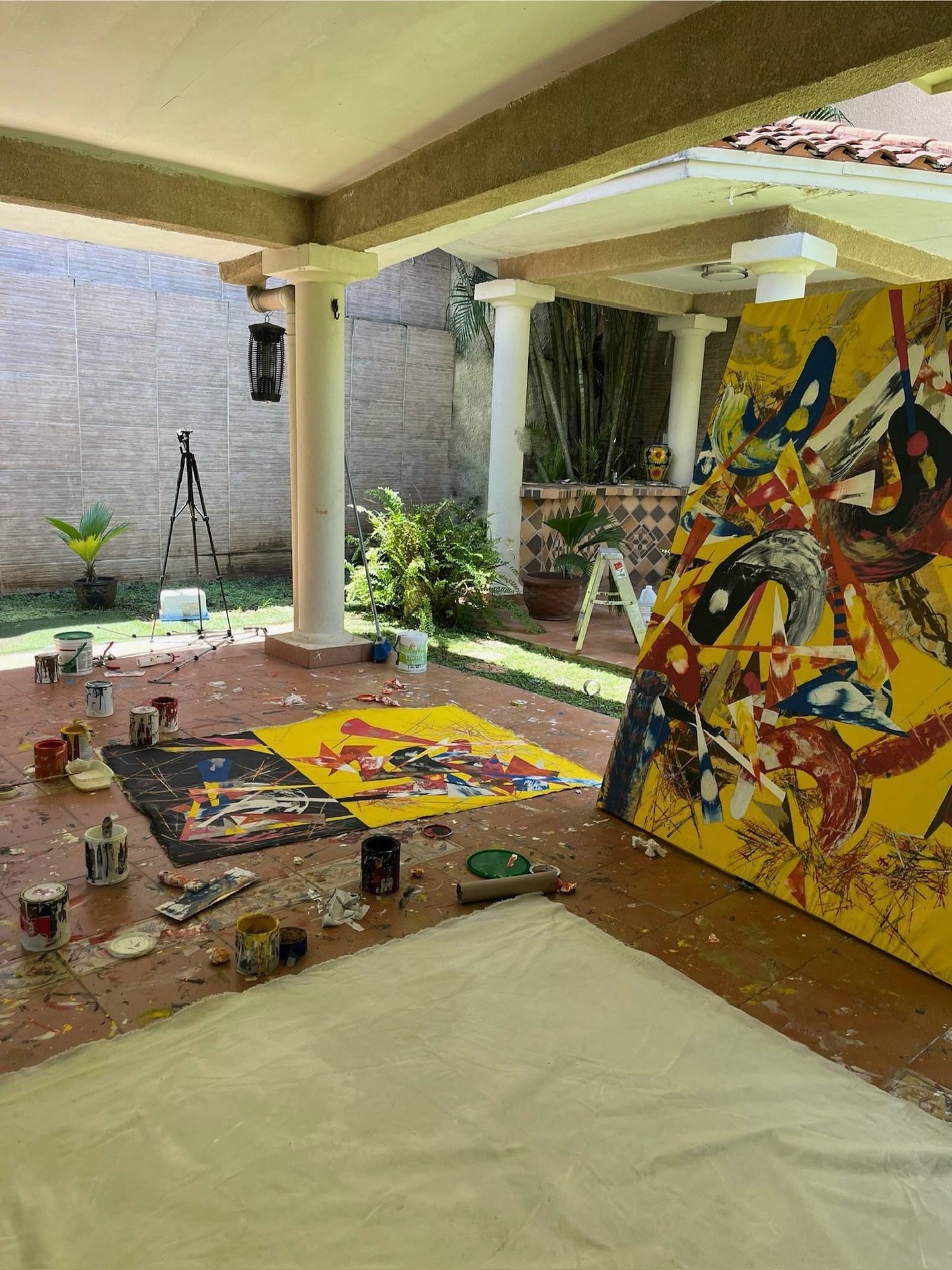
People often ask about my process. They see the finished paintings—geometric, complex, visually dense—and wonder how I get there. What's the actual workflow? How do I move from concept to completed work?
The answer involves planning and spontaneity, control and surrender, intention and accident.
Step One: Conceptual Development
Every piece begins as a question or feeling that needs investigation. In the refraction series, the question was: How can I visually represent the three phases of light refraction—incident, point of incidence, refraction? I spend time with this question before I touch paint. Sketching ideas. Thinking about color. Researching the actual physics. Understanding what I'm trying to communicate conceptually.
Step Two: Structural Mapping
Before paint touches canvas, I prepare the surface and map my composition. I work on self-primed canvas—white surface that's been sealed for better acrylic adhesion. Using graphite or diluted paint, I draw the geometric divisions that will structure the piece. These lines are guidelines, not rules. They provide structure, but remain flexible.
Step Three: The Pour
Now the spontaneous part begins. I pour fluid acrylic into the mapped geometric areas. This isn't random, but it's not fully controlled either. I'm paying attention to color sequence, pour amount, pour location, canvas angle, and timing. As colors pour, I'm watching how they behave. Do they merge at the boundaries as I hoped? Are unexpected color combinations emerging that I want to encourage? This is where the technique gets its power—the balance between my intention and the materials' autonomous behavior.
Step Four: Layering and Accumulation
As the first layer dries, I add another layer. And another. Each layer adds complexity. Colors interact with layers beneath. New combinations emerge through translucency. With each layer, I'm assessing the work: Does this area need more visual weight? Should this color advance or recede? Where should the eye focus? Layering is where intuition becomes crucial.
Step Five: The Flattening Process
As layers accumulate, I apply chromatic flattening. I'm not trying to create traditional depth or perspective. I'm compressing visual complexity into a unified picture plane while maintaining richness. This involves color modulation, value orchestration, and form compression. The result is visual depth without perspective. The surface remains flat, but appears to contain dimensionality.
Step Six: Metallic Integration
At key points—particularly "points of incidence" in refraction work—I introduce metallic elements. Metallic paints catch light physically. The work doesn't just depict the concept—it enacts it. They suggest transition and liminality, and they're reflective, creating dialogue between internal work and external viewer.